2027_2031 Research Project: Transforming Biennials. Politics, Places, Practices, and Histories in the Barents Region
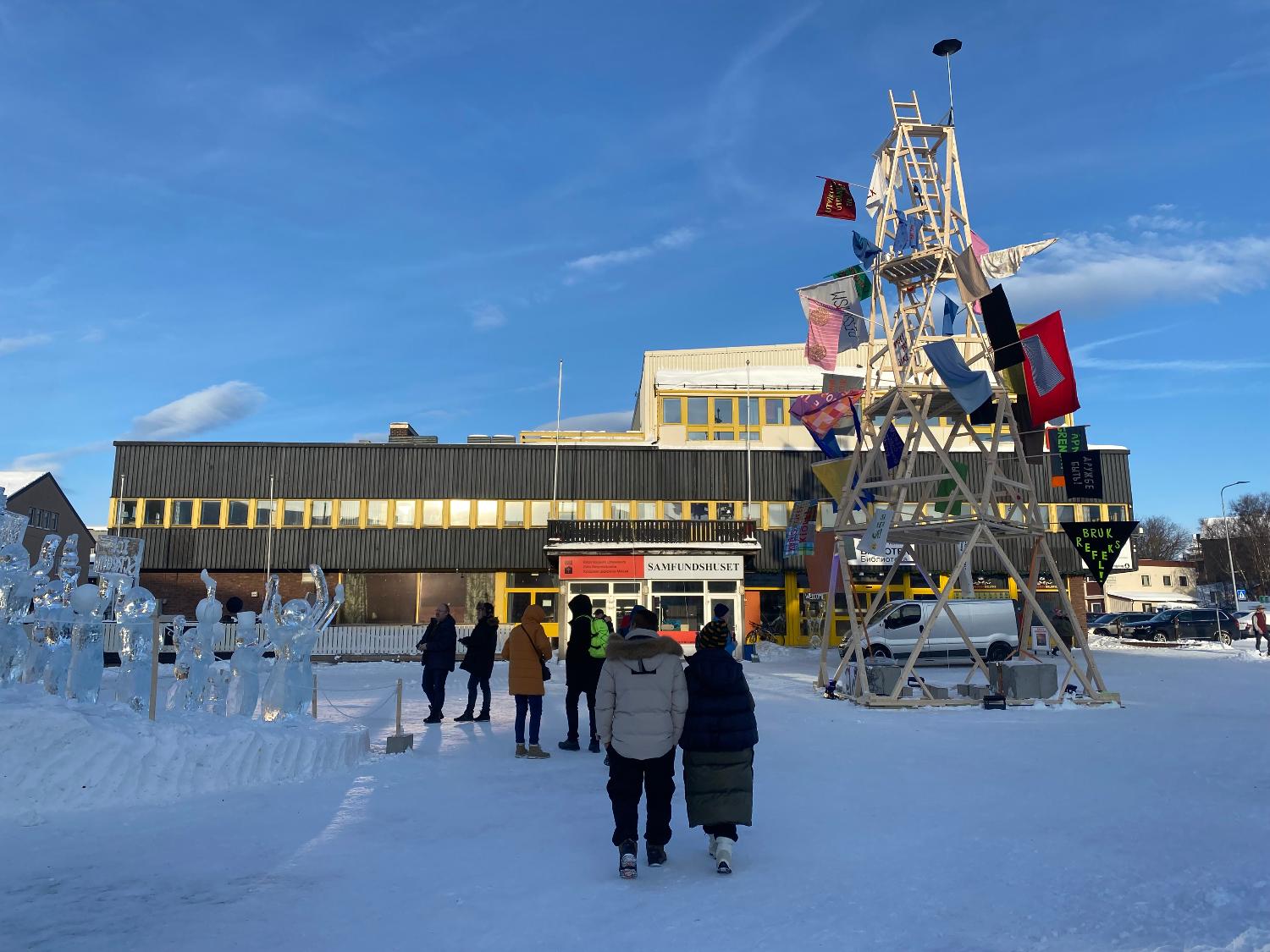 Barents Spectacle Kirkenes 2025. Photo Elin Haugdal
The upcoming project Transforming Biennials. Politics, Places, Practices, and Histories in the Barents Region investigates the role of biennials in the Barents Region to generate new knowledge about the role of culture in societal development and to enhance understanding of how art and culture influence sustainability, inclusion, participation, identity, and quality of life in a time of significant societal change.
The term "biennial" is typically used to refer to large-scale exhibitions of international contemporary art and encompasses not only biennials but also triennials and other major exhibitions that occur at longer intervals. The concept of the biennial can also be applied to cross-border initiatives such as the Barents Spektakel in Kirkenes. Two of the earliest established biennials (1990s) in Scandinavia, the Luleå Biennial and the Lofoten International Art Festival (LIAF), are held in the Barents Region.
In the introduction to The Biennial Reader (2014), Filipovic, van Hal, and Øvstebø call for what they term "biennialogy" – “the study of something in a systematic, rigorous way in order to generate a body of knowledge.” The editors convincingly argue that biennials attempt to make sense of contemporary culture and that there is a need to examine them not only to understand what is at stake in the art field but also to comprehend today’s world.
Even though there has been an increase in research on biennials since The Biennial Reader was published ten years ago (see, for example, Green and Gardener 2016; Kolb, Patel, and Richter 2018; Kolb, Patel, and Richter 2020), surprisingly little has been written about biennials in the Nordic North. How did they emerge? What artistic and curatorial practices do they generate? What topics do they address? How do the biennials in the Barents Region adapt to and resonate with local sites, and what place-making activities do they produce? How do they respond to and reflect the politics of nation-states and the geopolitical situation?
Do they impact the practices of the broader field of contemporary art, and are they comparable to biennials in the southern parts of the Nordic countries or even internationally? Is there potential for the continued relevance and future of these biennials, and do they foster resilient communities in the long term?
Members:
Financial/grant information:
In progress