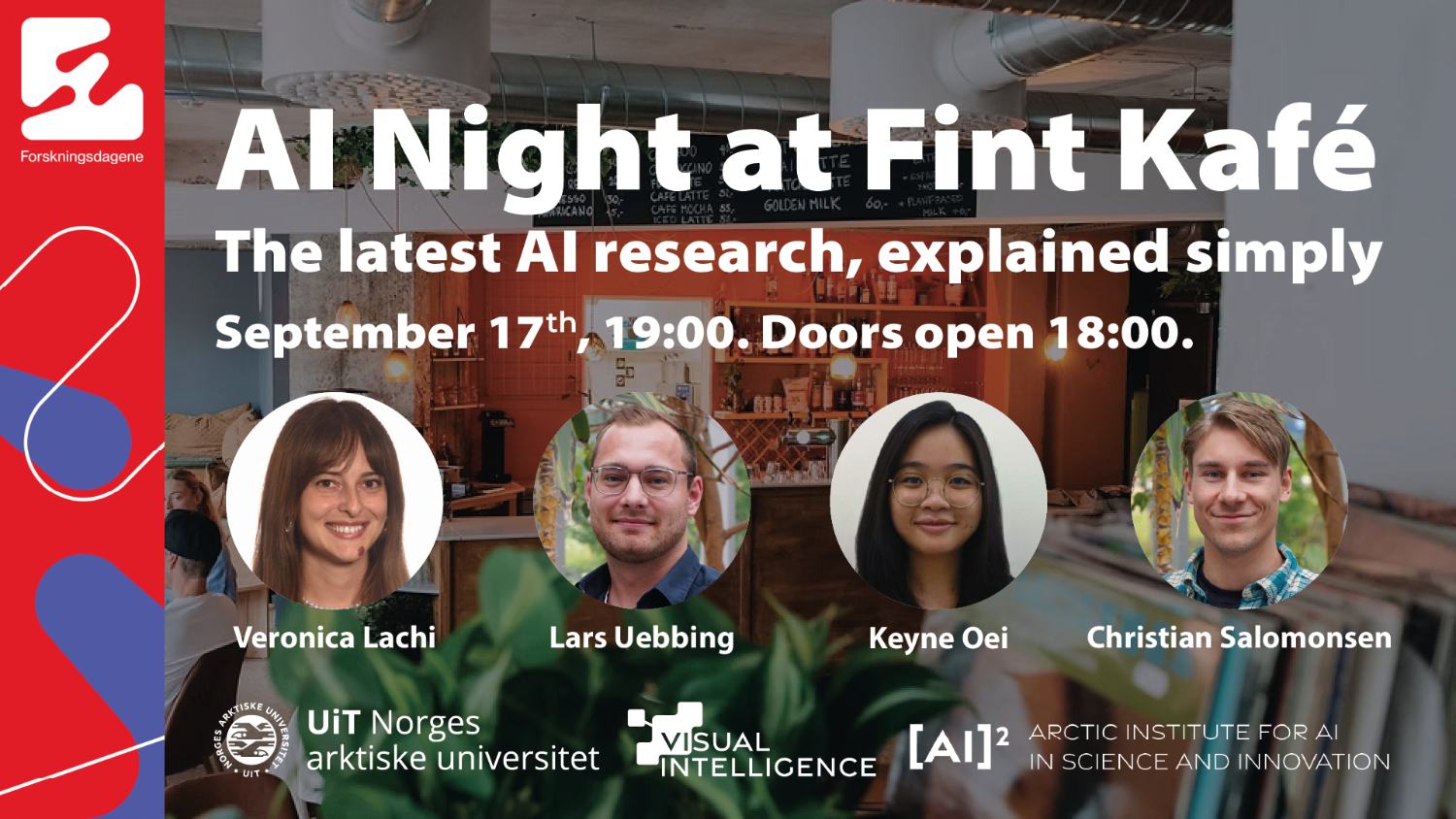
AI Night at Fint Kafe & Bar
How can AI help detect diseases within our body? How can it monitor the Arctic climate? And how does AI even learn how to do these things in the first place?
Come join us in Tromsø city centre, where we'll bring together Visual Intelligence researchers to share their latest research – explained in simple terms
When: September 17th, 19:00 - 20:30 CET (Doors open 18:00)
Where: Fint Kafé and Bar
These researchers will present their AI research and expertise on the following topics:
Free entry. Well met!
NB: The event and presentations will be held in English
Machines can recognise faces, write stories, recommend your next song, but how do they actually learn to do any of this? And what does “learning” even mean for a machine?
In this short journey into artificial intelligence, we’ll see how computers learn from examples, make mistakes, and slowly get better –a little like us, but also in some surprisingly different ways.
IceNet is an AI system that predicts Arctic sea ice extent up to 6 months into the future. Using 50 different input variables, it learns from decades of satellite observations and climate data to recognize patterns and tell us where sea ice is likely to form, melt or remain. Unlike traditional forecasts that give a single concrete prediction, IceNet can estimate the probability of different outcomes.
In this talk, I will show how IceNet could be useful for understanding how the Arctic may change and for preparing for extreme events, such as unusually low summer sea-ice conditions, and how AI-based forecasting systems can complement traditional climate models and help us better understand and predict our changing planet.
Electronic health records created during visits to doctors and hospitals contain rich information about our health. With machine learning, we can use these records to identify patterns and predict future health outcomes. These predictions may support earlier interventions, better-informed clinical decisions, and more personalized care.
This presentation will explore how machine learning methods are used in healthcare, the challenges involved, and their potential benefits for patients and healthcare professionals.
AI might replace your accountant. But could it also replace your blood test?
Dynamic PET creates a movie of a radioactive tracer travelling through the body, allowing us to study how tissues, organs and tumors function rather than simply what they look like. Deep learning can find information in these movies that is difficult, even painful, to obtain otherwise.
This talk explores what AI can uncover in dynamic PET, and what happens when we let computers look at medical images in new ways.